
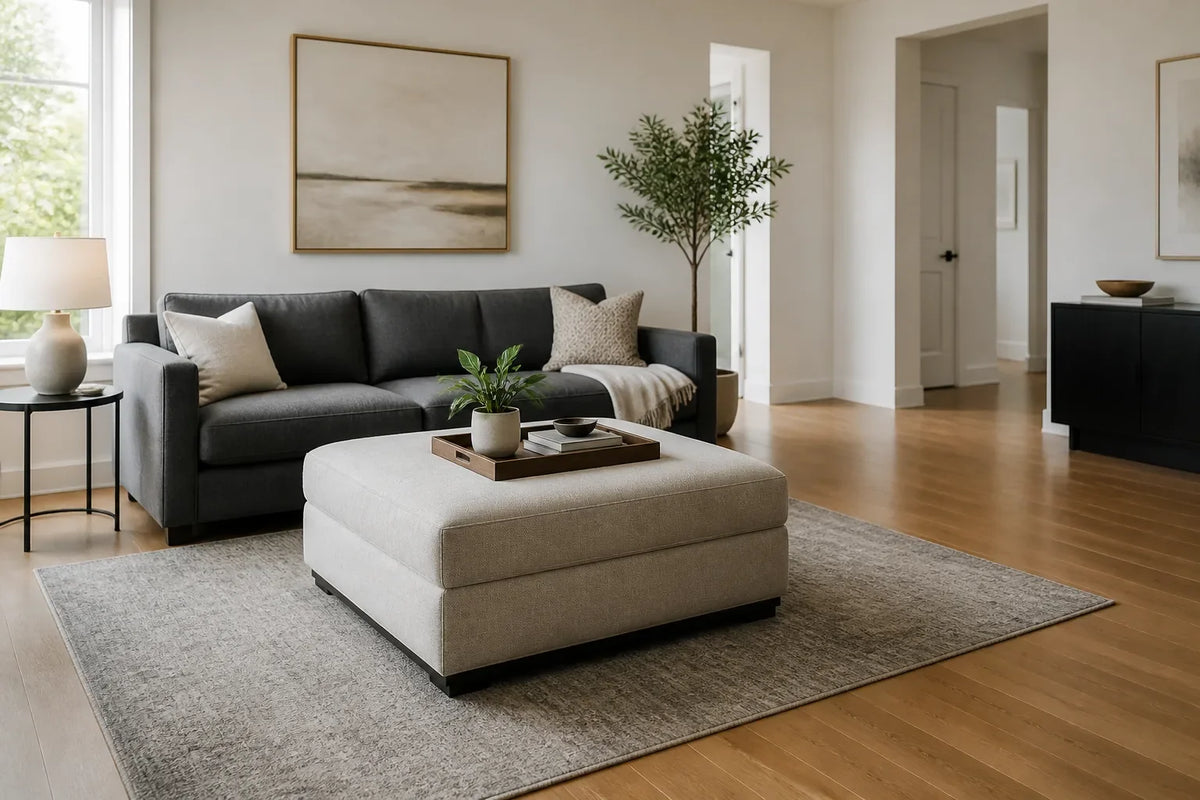
Quick Answer
A good ottoman should make your living room easier to enjoy. Start by deciding what you want it to do: hold blankets, give you a place to put your feet up, offer an occasional extra seat, or take the place of a coffee table. Then check that it suits your sofa, your walkways, and the way your household actually uses the room. When you have those answers, browse living room ottomans with a much clearer idea of what will work.
TL;DR
- Give the ottoman one main job: footrest, storage, occasional seat, or soft coffee-table alternative.
- Measure it in relation to your sofa and leave comfortable room to move around it.
- Choose the cover for real life, including feet, pets, kids, trays, and sunlight.
- Pick a coffee table instead if drinks, meals, or a laptop need a steady surface every day.
- Tape the footprint on your floor before falling in love with a piece online.
Table of contents
- First, decide what your ottoman is for
- Ottoman or coffee table?
- Find a size that feels right in the room
- Choose upholstery for the life you live
- Try a layout that keeps the room flowing
- Three easy mistakes to avoid
- What to check in the showroom
- Your before-you-buy checklist
- Frequently asked questions
Introduction
Ottomans have a habit of looking wonderfully simple in photos. Bring one home, though, and it quickly becomes part of everyday life. Feet land on it. Trays get balanced on it. Blankets disappear inside it. When company arrives, someone may pull it over for a seat.
That is why choosing one by colour alone rarely works. The right ottoman is not just the one that looks good beside your sofa. It is the one that quietly solves a problem in the room.
Maybe your family room needs somewhere to hide a mountain of throws. Maybe the best seat on the sofa is missing a footrest. Or perhaps you want to soften a room that feels a little too full of hard edges. Once you know which problem you are solving, size, shape, and upholstery become much easier to judge.
Perfect Home Furniture has been locally owned since 2000, with Calgary and Airdrie showrooms and more than 87,000 square feet of retail and warehouse space across the two locations. Use this guide to narrow the possibilities at home, then compare scale, firmness, and fabric in person.
First, Decide What Your Ottoman Is For
Before you think about colour or fabric, finish this sentence: “I want an ottoman so that I can _____.”
Your answer might be “put my feet up,” “hide the kids’ toys,” “seat one more person,” or “replace the coffee table.” It sounds almost too easy, but this one decision keeps you from asking a single piece to do four jobs badly.

| Role | What it is for | What to compare |
|---|---|---|
| Footrest | Legs up at one seat | Height next to that sofa or chair seat |
| Extra seating | Occasional sit for a guest | Whether that model is intended as a seat, and how firm the top is |
| Storage | Blankets, toys, extra pillows | Opening style, interior size, and whether a tray must move first |
| Cocktail / centre piece | Soft stand-in for a coffee table | Length versus the sofa, walking space, and whether you still need a tray |
The collection includes matching-line ottomans, oversized accent ottomans, and models labelled for storage, with availability changing over time. Product names and specifications matter here. An upholstered top does not automatically make an ottoman a seat, and a large top does not necessarily make it a practical table.
When Storage Is the Real Priority
Storage ottomans are especially good at swallowing the bulky, soft things that never seem to have a home: throws, pillows, toys, and board games. Open the lid, drop everything in, and the room feels calmer.
The catch is that the lid needs to remain usable. If a tray, books, and décor live on top, you will have to clear them every time you want a blanket. It is also worth lifting the top yourself to see whether it feels comfortable and checking whether the interior is truly large enough for what you plan to store.
If your clutter is mostly remotes, charging cables, and magazines, a table with drawers or a shelf may keep those smaller items better organised. In that case, compare living room tables before assuming an ottoman is the answer.
Matching Footrest or Oversized Centre Piece?
A matching ottoman usually feels like an extension of the sofa. It shares the cover and a related height, and it can tuck in front of one favourite seat. This is often the simplest choice when one person wants to stretch out without rearranging the entire room.
An oversized accent ottoman has a bigger presence. It sits in the middle of the conversation area, where several people can reach it. In front of a living room sectional, it can become the soft centre of movie nights, board games, and casual gatherings.
Neither style is automatically small. Check the full width and depth, even when the ottoman is designed to match a sofa.
Can It Really Be an Extra Seat?
An ottoman can be handy when a guest needs somewhere to perch for a while. It is less convincing as the place someone sits every evening, since it offers no back support. If you are really trying to create a daily reading spot, an accent chair will probably serve the room better.
Before anyone sits on an ottoman, confirm that the specific model is intended for that use. A photo cannot tell you how the piece is constructed or what weight it is designed to hold.
Ottoman or Coffee Table?
Picture a normal evening in your living room. Are you more likely to put your feet up, or put down a mug and a laptop? That everyday habit is more useful than any design rule.
An ottoman makes the room feel softer and more relaxed. A coffee table gives you a stable surface that is always ready. Some rooms benefit from both, perhaps an ottoman near the seat used for lounging and an end table within reach for drinks.

| Factor | Living room ottoman | Coffee table |
|---|---|---|
| Daily drinks and a laptop | Needs a firm, stable tray | Built-in hard surface |
| Footrest | Yes, on models meant for that use | Poor |
| Extra seating | Yes, when the model is intended as a seat | Limited |
| Hidden storage | Often a single cavity under the lid | Drawers, shelves, or a lift top, depending on the table |
| Soft edges | Upholstered sides | Wood or stone edges |
| Visual weight | Softer, more casual | More structured |
If you like the softness of an ottoman but still need somewhere for a drink, a sturdy tray can help. Think of it as a temporary tabletop, not a complete substitute for one. It should sit level without sliding and leave enough room for the ottoman to keep doing its other job.
If a hard surface is non-negotiable, explore living room tables instead.
Find a Size That Feels Right in the Room
Furniture photos are wonderfully good at hiding scale. An ottoman that looks tidy online can dominate a small room, while one that appears generous may feel lost beside a deep sectional. The answer is not a universal “ideal” size. It is proportion.

Start with the sofa. You want the ottoman top to feel comfortably related to the seat height, especially if you will use it as a footrest. Then look at length and depth. The piece should feel substantial enough for the seating around it without filling every inch of open floor.
The Painter’s Tape Test
Before you shop, mark the proposed footprint on the floor with painter’s tape. Then live with the outline for a few minutes:
- Sit down and stand up from every nearby seat.
- Walk the route you normally take through the room.
- Open nearby doors, recliners, or storage furniture.
- Look at the outline from the doorway, not just from the sofa.
- Add a second taped outline if you are comparing two sizes.
This simple test reveals crowding much faster than dimensions on a screen. Remember to include any side table or coffee table that will stay in the room.
Pay Attention to the Way People Move
The most important space is often not the empty area around the furniture, but the route people use to get past it. A beautiful ottoman becomes irritating if everyone has to turn sideways to reach the sofa.
| What to compare | Why it matters |
|---|---|
| Overall height | Feet should rest without hiking a knee or dropping too far |
| Overall length and width | The piece should leave room to walk and to sit down |
| Shape | Round or oval pieces can ease traffic; rectangles can align with a sofa |
| Lid or storage opening | You need clear space to open it |
| Packed or shipping size | The piece still has to enter the home |
For a household that needs an accessible route, Government of Canada accessible-design guidance uses a clear path of at least 900 mm as a benchmark for accessible projects. That is not a universal decorating rule, but it is a useful planning reference when an unobstructed route matters.
Do Not Forget the Trip to the Living Room
The ottoman also has to make it through the front door. Measure the narrowest doorway, hallway, stair turn, and elevator opening along the route. Oversized pieces can be deceptively bulky, even when they are not especially tall.
Ask whether the legs can be removed on the model you are considering. If the route is tight, review the available furniture delivery options, including Curbside, Drop, and VIP service, with an associate before ordering.
Choose Upholstery for the Life You Live
An ottoman tends to work harder than it looks. It meets shoes, bare feet, snack trays, pet hair, and the occasional spill, often all in the same week. Choose the cover for that reality first and your colour palette second.
| Cover type | Often a good fit when | Ask before you buy |
|---|---|---|
| Performance fabric | Kids, pets, everyday feet | How to clean spills on that fabric |
| Texture weaves | You want hide-the-wear pattern | Whether the nap shows footprints |
| Leather or leather look | You want a wipeable top | Care products and sunlight fading |
| Shearling or high pile | The look is the point | How it handles feet, pets, and trays |
Run your hand across the fabric. Press on it. Set down the kind of tray you expect to use. Ask how spills should be cleaned and whether the texture tends to show footprints or pressure marks. Two fabrics that look almost identical can behave very differently at home.
Direct sunlight can also fade some dyes over time, so mention it if the ottoman will sit close to a bright Calgary or Airdrie window.
If you are pairing the ottoman with a sofa you already own, bring a cushion or a clear photo taken in daylight. The pieces do not need to be an exact match. A related colour, texture, or visual weight can feel more intentional than a near-match that is just slightly off.
Try a Layout That Keeps the Room Flowing
There is no rule that says an ottoman must sit squarely in the middle of the sofa. Let its job determine its place. A footrest can stay close to one seat, a storage ottoman can sit slightly to the side, and two smaller ottomans can move wherever the evening takes them.

| Placement | When it helps | Watch for |
|---|---|---|
| Matching ottoman at one seat | A coordinated footrest | Blocking the path past that seat |
| Cocktail ottoman in the centre | Sectionals and sofa-plus-chairs layouts | Filling the entire well |
| Two smaller ottomans | Flexible seating that can move | Extra pieces to store when not in use |
| Storage ottoman to one side | Hidden blankets without blocking the TV view | Lid swing into a walkway |
In an open-concept home, test the route from the kitchen and dining area into the living room. A large ottoman can help define the seating zone, but it should not become an obstacle in the path everyone uses.
If the sofa is part of the decision too, our guide to choosing a living room sofa can help. You can also compare living room sofas and living room sectionals as a complete seating plan.
Three Easy Mistakes to Avoid
1. Shopping for the Look Before the Job
This is how people end up with a beautiful storage ottoman they never open or a soft cocktail ottoman that frustrates them every time they put down a drink. Decide what the piece needs to do on an ordinary Tuesday night, not just how it should look in a finished room.
2. Filling Every Inch of Open Space
An oversized ottoman can look inviting in front of a sectional, but people still need space to sit down, stand up, and reach the corner seats. Tape the entire seating area and walk around it. If you notice the outline every time you pass, the real piece will not feel any smaller.
3. Trusting the Photo More Than the Test
A photo cannot tell you whether your feet rest comfortably, the lid feels heavy, or a tray wobbles on the fabric. When possible, sit beside the ottoman, put your feet up, open the storage, and try the top the way you will use it at home.
What to Check in the Showroom
Bring your room measurements, a few photos, and a simple sketch showing doors and walking paths. Then slow down and try the ottoman instead of only looking at it.
Tap to check off as you go
Buying online can work well when you already know the role, size, and access route. If any of those details still feel uncertain, an in-person visit can answer them faster. Perfect Home has free parking at both the Calgary and Airdrie showrooms: 48 Heritage Gate SE in Calgary and #150, 2771 Main Street S in Airdrie.
Your Before-You-Buy Checklist

If the choices are starting to blur together, come back to these eight steps:
Tap to check off as you go
Frequently Asked Questions About Choosing an Ottoman
Next steps
You do not need to know exactly which ottoman you want before you start looking. You only need three things: its main job, the size of the space, and a clear picture of how your household will use it.
With those notes in hand, browse living room ottomans online or bring your measurements to one of our showrooms. An associate can help you compare in-stock pieces, available custom or special-order options, and the right delivery service for your home. If you are planning the whole room at once, start with the full living room furniture collection.
---