
Quick Answer
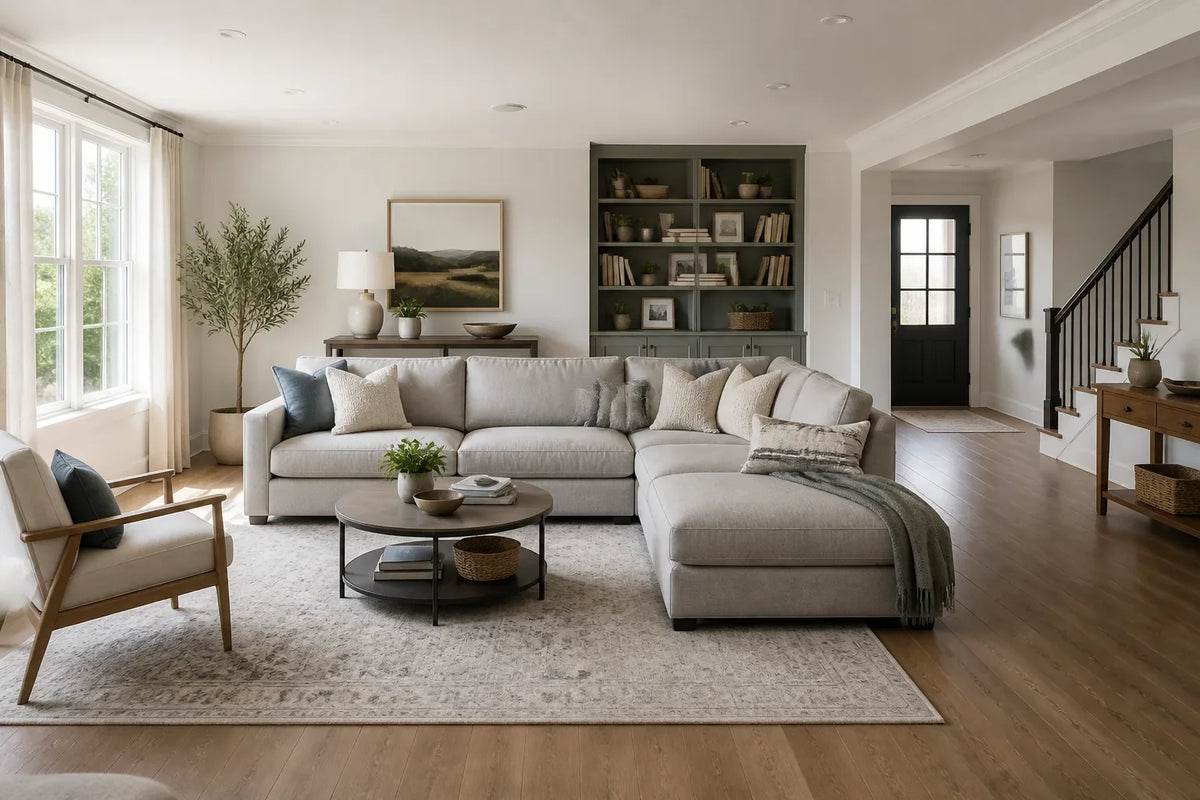
A living room couch sectional works when the layout matches how you sit, the chaise faces the correct way, and the piece (or its modules) can travel through your home. Start with the room: traffic paths, TV or fireplace wall, and the doorway you enter from. Then confirm left- or right-facing orientation, measure the full footprint, and compare depth and fabric in person. When you are ready to browse, start with living room sectionals.
TL;DR
- Sketch how people sit, walk, and watch TV before you pick a colour.
- Stand facing the sectional to name left-facing or right-facing chaise. Do not decide from the seated view.
- Measure wall length, chaise projection, walkways, and the path indoors (doors, stairs, elevator).
- Sit for several minutes. Depth that feels right for movie night may feel too deep for upright conversation.
- If timing matters, start with in-stock furniture. If you need a configuration or fabric that is not on the floor, ask about custom and special-order furniture.
Table of contents
- Start With How You Use the Room
- Confirm Left-Facing or Right-Facing Chaise
- Measure the Room for a Sectional
- Measure the Path Into the Home
- Choose Size, Depth, and Configuration
- Pick Materials That Match How You Live
- Test Comfort in the Showroom
- Common Sectional Buying Mistakes
- Decide In-Stock vs Custom or Special Order
- Illustrative Household Scenarios
- Showroom Checks Before You Buy
- Sectional Measuring Checklist
- Frequently Asked Questions About Choosing a Living Room Sectional
Introduction
A sectional for the living room is a connected seating zone, not a longer sofa. It occupies a corner or a large wall, sets traffic around it, and is harder to move once it is in place. Colour is the easy part. Layout, chaise direction, depth, and delivery access decide whether it still feels right after the first month.
This guide follows the decision in order: how you use the room, which configuration fits, how to name chaise orientation, what to measure in the room and on the path indoors, then comfort, fabric, and in-stock versus custom. Comparison tables and a checklist help you apply the same steps at home.
Perfect Home Furniture is a locally owned retailer since 2000, with Calgary and Airdrie showrooms and over 87,000 sqft of retail and warehouse space across both locations combined. The notes here match what shoppers typically compare on the floor and with partner manufacturers: measurements, configuration, fabric, comfort, and delivery access. Use them whether you are browsing living room furniture online or visiting a showroom.
By the end, you will know how to choose a living room sectional, how to confirm chaise direction, what to measure, and which questions to ask before you order.
Start With How You Use the Room
Match the sectional to daily use first, then to wall length. Sketch who sits where, where people walk, and what they face (TV, fireplace, or conversation). That sketch tells you whether you need an L, a chaise lounge side, modular pieces, or a smaller sofa-and-chairs mix instead.

Common layouts to compare:
- L-shaped sectionals for open plans, family rooms, and corners that can own one continuous seating zone.
- Chaise sectionals when one side needs a lounging stretch for reading or movie nights, without a full U.
- Modular sectionals when you want pieces you can rearrange after a move, a renovation, or a change in how the room is used.
- U-shaped sectionals when the room is large enough for seating on three sides and walkways still clear. They take more floor than an L.
- Reclining sectionals when headrest or footrest motion matters for daily lounging. Confirm power or manual options, and leave space behind the piece to open.
- Sleeper or storage sectionals when guest sleep or hidden storage is part of the job, and those options are available on the line you like.
If you need a simpler footprint with chairs and more flexible traffic flow, compare living room sofas before you commit to a large L. For whole-room planning (tables, storage, and seating together), browse living room furniture, then return here for sectional-specific measuring.
| Layout | Often a fit when | Watch for |
|---|---|---|
| L-shaped | One corner can own seating; walkways stay clear | Chaise blocking the kitchen or hall path |
| Chaise sectional | One person needs a long lounge side | Wrong left/right orientation |
| Modular | The room may change after a move or renovation | Pieces that only connect in one order |
| U-shaped | A large family room or media space | Traffic trapped inside the U |
| Reclining | Movie-night lounging is the main use | Clearance behind the back cushions |
| Sofa + chairs | Doorways, hall turns, or a narrow room make a large L awkward | Less connected seating for movie night |
Quick layout check:
- Choose an L-shape if one corner can own the seating and walkways still clear.
- Choose a chaise sectional if one person needs a long lounge side.
- Choose modular if you expect to reconfigure later.
- Choose a sofa-plus-chairs mix if doorways, hall turns, or a narrow room make a large sectional awkward.
Confirm Left-Facing or Right-Facing Chaise
Chaise direction is one of the most common sectional mistakes. Labels are from the front of the piece, not from sitting on it. Use this method before you order.

- Stand facing the sectional as it would sit in the room (looking at the seat fronts).
- Note which side the chaise extends on.
- That side names the orientation: chaise on your left is left-facing; chaise on your right is right-facing.
Do the same check against your room sketch. Mark the TV wall, fireplace, windows, and main doorway. The chaise should land where lounging makes sense without blocking the main walkway from the entry to the rest of the home.
A useful rule of thumb: put the chaise toward the quieter corner, away from the path people use to enter the room. If the main door is on the left as you face the TV wall, a right-facing chaise often keeps that path clearer. If the door is on the right, a left-facing chaise often does the same. Confirm with tape on the floor. Rooms with two doorways, a kitchen pass-through, or a basement post may break the simple rule.
Bring the sketch (or photos of the walls) to the Calgary or Airdrie showroom. Both locations carry a rotating selection of sectionals. If you are looking for a specific configuration, call ahead before your visit.
Not every sectional is reversible. Do not assume you can flip the chaise after delivery unless the line is built that way. Ask on the floor.
Measure the Room for a Sectional
Room fit is more than one wall length. Capture the full footprint the sectional will occupy, including the chaise projecting into open floor.

Write down:
- Length of the primary wall (or walls) the sectional will sit against.
- Chaise projection into the room (how far the lounge side extends from the back cushions toward open floor).
- Clear walkways past coffee tables, ottomans, and door swings.
- Distance to the TV wall or fireplace so viewing angles and glare stay comfortable.
- Rug size if you plan the sectional on or around a rug.
- Window, heat vent, and radiator clearances if the piece sits under windows.
Use painter's tape to mark the footprint on the floor before you shop. Walk the taped outline the way you would on a normal evening: entry to kitchen, kids' path, and the route to the TV. If you have to sidestep the tape, the piece is too large for how you live.
Open Airdrie family rooms and many Calgary basement rec rooms have space for an L-shape. Downtown condos and townhomes often need a shorter chaise, a compact L, or a modular mix that keeps the kitchen pass-through clear. Measure twice: once for the walls, once for the traffic path around the piece after it is placed.
Measure the Path Into the Home
A sectional can fit the wall and still struggle on the stairs. Measure the route from the street entry to the final room, not only the living room itself.
Capture:
- Exterior door, garage door, or loading access.
- Interior doorways on the route.
- Hallway widths and sharp corners.
- Stair width, railing clearance, and landing size.
- Elevator door opening and cabin depth and height for condo deliveries.
Compare those openings to the sectional's packed dimensions, or to each modular piece if it ships in sections. Modular and multi-piece designs are often easier to move through tight Calgary condo halls than a one-piece frame of the same finished size.
Review furniture delivery options for Curbside, Drop, and VIP service in Calgary, Airdrie, and surrounding communities, and share tight-access details when you order. Delivery is not free by default, and timing for in-stock pieces still depends on the route. Confirm the option and access notes at purchase.
Choose Size, Depth, and Configuration
Choose size from the measurements you already took, not from how the piece looks on a showroom platform. A living room couch sectional that fills a large family room can overwhelm a condo. A compact L that fits a townhome may look small in an open-plan basement.

Seat depth is a comfort choice as much as a space choice. A deeper seat suits lounging and movie nights. A shallower seat often suits upright conversation and shorter-legged sitters. Sit in more than one depth. Notice whether your feet reach the floor if that matters to you, and whether you can get in and out without using the arms as a lever.
| Feature | Standard sofa | Sectional |
|---|---|---|
| Best for | Most room layouts; rooms that may change | One main lounging zone in a larger living room |
| Seating | Usually 2–4 people | Usually more people in one connected area |
| Flexibility | Easier to move and rearrange | Less flexible once placed, unless modular |
| Space | Moderate footprint | Larger footprint, including chaise projection |
| Often a better fit when | Walkways, doorways, or future layout changes matter most | The household wants one shared seating zone |
Neither option is universally better. If you are still deciding between a sofa and a sectional, read how to choose a living room sofa for sofa sizing, then come back here for chaise direction and the larger footprint.
When comparing living room sectionals, pay attention to chaise orientation, wall length, and traffic flow. A sectional often works well in family rooms and basement media areas. In condominiums, apartments, or rooms with several doorways, a regular sofa or loveseat may suit better.
Pick Materials That Match How You Live
Choose upholstery for how the room is used, not only how it looks under showroom light. Families, pets, and frequent guests usually need a different cover than a low-traffic sitting room.
Fabric offers a wide range of colours and textures. Performance fabrics are often easier to clean and more resistant to stains and everyday wear. Leather wipes down easily and can develop a patina. It may also show pet scratches more readily. There is no single better material. It depends on the household.
Things to compare in person:
- How the fabric feels after you sit, not only how it looks on a swatch card.
- Whether cushion covers are removable, if that matters for cleaning.
- How a darker colour or a pattern hides fur and small marks between cleanings.
- Cleaning notes from the manufacturer for the specific cover. Ask in store. Do not assume every "performance" label means the same care.
If you need a fabric, leather, or finish that is not on the floor, ask about custom and special-order furniture through partner manufacturers. Many sectionals can be customized with different configurations, fabrics, and finishes. Not every line offers every option.
Frame and cushion construction vary by manufacturer. Ask how the joints are made, what fill is in the seats, and what warranty covers the frame, cushions, and mechanisms. Treat those answers as model-specific. They are not a storewide spec.
Test Comfort in the Showroom
Seat depth and cushion feel are personal. A deep sectional can feel right for movie nights and still feel too deep for upright conversation. Sit in a few profiles and notice:
- Can you plant both feet on the floor if that matters to you?
- Do the cushions feel supportive after a few minutes, or do you sink more than you want?
- Is the back height comfortable for your usual posture?
- Does the chaise length work for the tallest person who will use it?
- If the piece reclines, is there space behind it in your room, and is the motion easy to use?
Stay for several minutes, not a brief perch. Cushions feel different once they compress. Sit in the corner, on the chaise, and in the middle seat. Comfort can change by position.
Bring fabric notes for pets, kids, and cleaning expectations. Colour and texture are easier to judge with swatches under showroom light than from a screen alone. Perfect Home's Calgary and Airdrie showrooms are set up for that comparison: sit, feel fabrics, and check the configuration against your sketch.
Common Sectional Buying Mistakes
Most sectional regrets come from skipping a measurement or naming chaise direction from the wrong viewpoint.
- Ordering from the seated view. Stand facing the piece. Left and right reverse if you sit first.
- Measuring one wall only. The chaise still needs open floor, and people still need a path past the coffee table.
- Ignoring the path indoors. Stairs, railings, elevator cabs, and hall turns stop more sectionals than the living room wall does.
- Choosing size from a photo. Showroom platforms and wide-angle listing photos hide scale. Use tape at home.
- Assuming every sectional is reversible or modular. Ask how the pieces connect before you count on a future rearrange.
- Skipping a long sit. A cushion that feels plush for thirty seconds can feel too soft after a movie.
- Blocking heat vents, doors, or the kitchen pass-through. Walk the taped footprint at dinner time, not only at noon.
- Treating custom timing as a blog estimate. Confirm current timing with an associate. Do not rely on a generic week range.
Decide In-Stock vs Custom or Special Order
If timing matters and a floor or warehouse piece fits your layout, start with in-stock furniture. In-stock pieces are often on a faster delivery path than a made-to-order cover, but timing still depends on the route. Perfect Home does not promise immediate delivery for every in-stock item.
If you need a specific size, configuration, or fabric that is not on the floor, ask about custom and special-order furniture through partner manufacturers. Custom timelines vary by manufacturer. Confirm estimated timing, deposit terms, and configuration details in writing before you place the order.
Custom and special-order pieces follow different return rules than many in-stock items. Do not assume a custom sectional is returnable. Confirm the policy on the line you are ordering.
Illustrative Household Scenarios
The right sectional depends on the room, the household, and daily routine. The examples below show how the rest of this guide can be applied. They are illustrative situations, not named customer stories.
Open family room next to a kitchen
A mid-sized L can define the living zone in an open plan, but only if the chaise does not sit in the path from the entry to the kitchen. Tape both left- and right-facing footprints. Keep the pass-through clear even if that means a shorter chaise.
Downtown Calgary condo
Elevator cab size and hallway turns often matter as much as wall length. A compact L or a modular set that ships in sections is usually easier to deliver than a large one-piece frame. Measure the elevator door and cabin before you fall for a deep chaise.
Basement media room
Posts, a bar, and a large screen change the seating map. A reclining or deep sectional can work when there is clearance behind the back cushions and a clear route around the posts. Confirm packed dimensions against the stair and landing.
Household with children or pets
Performance fabric, a darker colour or pattern, and cushions that keep their shape under daily use usually matter more than a pale, delicate weave. Sit, then ask about cleaning notes for that specific cover.
Illustrative example: two configurations in the same room
Imagine a medium living room with an open kitchen on one side and a TV wall on the other. Two options: a three-seat sofa with two accent chairs, or a mid-sized chaise sectional.
| Factor | Sofa + accent chairs | Mid-size chaise sectional |
|---|---|---|
| Walkway to kitchen | Stays more open | Needs the chaise on the quieter side |
| Seating for movie night | Split across pieces | One connected lounge zone |
| Future layout changes | Easier to move individual pieces | Less flexible unless modular |
| Delivery | Smaller packed pieces | Check stairs and corners against packed size |
| Often a better fit when | Flexibility and open traffic flow matter most | Lounging in one zone matters most |
After marking both footprints with painter's tape, one household may find the sectional uses the corner well and still leaves the kitchen path, while another may find the sofa-and-chairs layout is the only way to keep two doorways clear. Sitting in both configurations in a showroom usually reveals a difference that photos miss.
Showroom Checks Before You Buy
If you are looking into how to buy a living room sectional, a few extra questions keep the choice on track.
- What packed dimensions should I compare to my doorways, stairs, and elevator?
- Is this configuration left-facing, right-facing, reversible, or modular?
- Which filling is used for the cushions, and are covers removable?
- How is the fabric rated for cleaning, and what does the warranty include on this model?
- Does this line offer customization of fabric or configuration through a partner manufacturer?
- How long will a custom or special order take? Confirm current timing with an associate.
Buying online can work if you already know size, orientation, and comfort. If those are still open, visiting the showroom answers them faster than photos. See Calgary and Airdrie showroom details.
How you know it is the right sectional
Tap to check off as you go
Sectional Measuring Checklist

Use this list before you buy:
Tap to check off as you go
Frequently Asked Questions About Choosing a Living Room Sectional
Next steps
When your sketch and measurements are ready, browse living room sectionals, compare depth and fabric in person at our showrooms, and confirm delivery options before you order. If you need a configuration or fabric that is not on the floor, review custom and special-order furniture with an associate.
---