
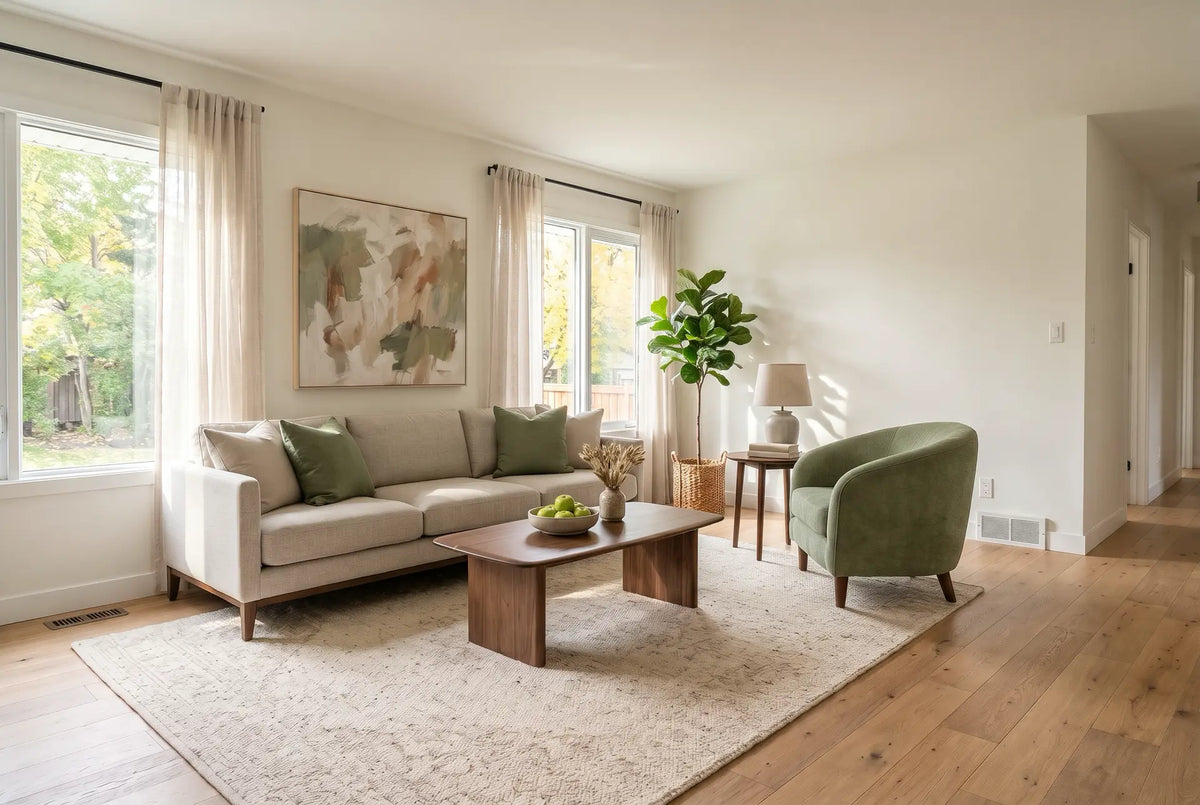
Quick Answer
Choose an accent chair by deciding what the seat must do, measuring its full footprint and walking space, and testing how its seat feels beside your sofa. Pick fixed or swivel movement before choosing colour, then compare the cover and frame with the way your household uses the room. Start your shortlist with accent chairs, then bring room photos and measurements to a Calgary or Airdrie showroom.
TL;DR
- Give the chair one main job: everyday seat, reading chair, flexible swivel seat, or occasional accent.
- Tape the full width and depth on the floor. Include arms, the back, swivel movement, and nearby tables.
- Compare the chair with the sofa by seat position, back height, visual weight, and viewing direction.
- Sit naturally. Check whether your feet, back, and arms feel supported for the time you expect to spend there.
- Choose a cover for pets, children, sunlight, spills, and care, not colour alone.
- Measure doors, halls, stairs, and elevators before ordering.
- Confirm the exact model's movement, materials, care, availability, and delivery details before you buy.
Table of contents
- Start With the Job the Chair Needs to Do
- Measure the Whole Chair Footprint, Not Just the Empty Corner
- Compare the Accent Chair With Your Sofa
- Test Comfort for the Way You Sit
- Choose Fixed or Swivel Movement
- Pick Upholstery and Frame Details for Daily Life
- Place One Chair or a Pair Without Blocking the Room
- Avoid Common Accent Chair Buying Mistakes
- Showroom Checks Before You Buy
- Accent Chair Buying Checklist
- Frequently Asked Questions About Accent Chairs
Introduction
An accent chair should earn its floor space. It may complete a conversation area, give one person a reading seat, turn toward two focal points, or add shape and texture beside a sofa. If it only fills an empty corner, it can quickly become a place to stack laundry.
The useful order is job, fit, comfort, movement, and then style. This guide follows that order without relying on one-size-fits-all measurements. You will compare each chair's listed dimensions with your room, sofa, body, and route indoors.
Perfect Home Furniture is a locally owned retailer serving Calgary and Airdrie since 2000. Across both locations, the business has over 87,000 sqft of retail and warehouse space. Browse accent chairs online, then compare your shortlist in person when comfort, movement, or scale is hard to judge on a screen.
Start With the Job the Chair Needs to Do
Give the chair one main job before you compare silhouettes or fabric. A chair used every evening needs a different comfort test from a light occasional chair that comes out for guests.

| Main job | What matters most | Useful showroom check |
|---|---|---|
| Everyday seat | Comfort over a longer sit, easy entry and exit | Sit in your normal position for more than a quick test |
| Reading chair | Back and arm support, nearby light and surface | Hold a book or device as you would at home |
| Flexible swivel seat | Turning between conversation, TV, window, or fireplace | Rotate through the directions you will use |
| Occasional accent | Compact footprint, easy placement, visual contrast | Confirm it is still comfortable enough for a guest |
Everyday Chair or Occasional Chair?
An everyday chair needs to suit the person who will use it most. Think about how long they sit, whether they prefer to sit upright or curl up, and how easily they stand. Do not assume a plush chair is automatically the most comfortable. Deep, low, firm, and soft seats all feel different to different people.
An occasional chair can be visually lighter and more compact. It still needs a usable seat, but it does not have to support the same evening routine as a reading chair.
One Chair or a Pair?
One chair can finish the open end of a sofa and turn slightly toward the conversation. A pair creates stronger balance across from a sofa or on each side of a focal point, but it doubles the footprint and the delivery planning.
Tape both chair footprints if you are considering a pair. Leave the tape down for a day and walk the room as usual. A layout that looks balanced from the doorway can still crowd the path to another room.
Statement Piece or Quiet Connector?
A statement chair can introduce a new shape, pattern, or texture. A quiet connector repeats a colour, wood tone, or line already in the room. Both approaches work when the chair shares at least one visual relationship with the surrounding furniture.
The chair does not need to match the sofa. It should look intentional beside it.
Measure the Whole Chair Footprint, Not Just the Empty Corner
Measure the chair zone as a working part of the room. Overall width and depth are only the start. Arms, an angled back, swivel movement, a side table, and the space needed to sit down all affect fit.

Mark the Floor Before You Shop
Use painter's tape to mark the widest and deepest points of a possible chair. Then add the pieces that make the seat usable: a lamp, table, footstool, or open drawer nearby.
Check the outline from four places:
- The room entrance.
- The sofa seat beside or across from it.
- The main walking path.
- The TV, window, or fireplace the chair may face.
If the chair swivels, test more than a static rectangle. Make sure its corners, arms, or back will not strike a wall, table, or another seat when it turns.
Measure the Route Into the Room
The chair must fit through the home as well as the room. Record the narrowest points along the route:
- Exterior and interior doors.
- Hallways and sharp turns.
- Stair width, landings, railings, and low ceilings.
- Elevator door and interior.
- The final turn into the room.
Ask whether legs or other parts are removable on the specific chair. Do not assume they are. Review furniture delivery options and share access constraints before ordering.
Compare Listed Dimensions, Not Product Photos
Photos can hide depth and back angle. Read the full dimensions for each model and compare them with the taped outline. If one listing measures length and another uses width, confirm which direction each number describes.
For a shortlist, write the dimensions in the same order every time. That makes two chairs easier to compare without relying on memory.
Compare the Accent Chair With Your Sofa
The chair and sofa should feel like part of one seating group, even when they are different styles. Compare where people sit, how high the backs appear, how much visual weight each piece carries, and which direction the seats face.
Compare Seat Position
Two seats can have similar outside dimensions and feel completely different. Compare:
- Seat height relative to the sofa.
- Usable seat depth after the back cushion.
- Arm height and width.
- Back angle.
- Cushion firmness.
The goal is not an exact match. The goal is to avoid a chair that feels disconnected because one person sits far lower, much farther back, or outside the conversation.
Balance Visual Weight
A deep sofa with broad arms may overpower a very delicate chair. A compact sofa can look crowded beside an oversized barrel chair. Look at the full outline: back height, arm thickness, visible legs, and how much floor the chair covers.
If the chair is visually heavy, give it breathing room. If it has open arms or visible legs, it may feel lighter even when its measured footprint is similar.
Coordinate Without Buying a Matching Set
Repeat one element and vary another. For example:
- Repeat a wood tone and change the upholstery colour.
- Repeat a colour family and change the shape.
- Repeat a curved line and change the texture.
- Keep the chair neutral and let its frame or silhouette add contrast.

If you are choosing the sofa at the same time, read how to choose a living room sofa and compare living room sofas before committing to the chair.
Test Comfort for the Way You Sit
A comfortable accent chair fits the person and the activity. Test it in the posture you will actually use rather than sitting perfectly upright for a few seconds.

Check Your Feet and Knees
Sit all the way back. Notice whether your feet rest comfortably, whether the seat edge presses behind your knees, and whether standing up feels natural. If you plan to curl up, try that position too.
Do not turn these checks into a medical claim. They are simply a way to compare how different chairs feel to you.
Check Your Back and Arms
The back should meet you where you expect support. A tall back can suit reading or a longer sit. A low back can keep sightlines open, but it may not support the shoulders or head.
Arm shape changes how a chair works. Wide arms take more floor space. Narrow or open arms can make the chair feel lighter. Armless chairs are easy to approach from the side, but they do not provide a place to rest an elbow.
Test the Real Activity
If the chair is for reading, hold a book or device and notice where your elbows land. If it faces a TV, look in that direction without twisting. If it is for conversation, check whether you can turn naturally toward the sofa.

When more than one person will use the chair often, each person should test it. Comfort is not transferable from a product description.
Choose Fixed or Swivel Movement
A fixed chair suits a stable layout. A swivel chair helps when the seat must turn between conversation, a TV, a window, or another room. Movement is a functional decision, not only a feature.

| Question | Fixed chair | Swivel chair |
|---|---|---|
| Does the chair face one main direction? | Simple fit | Movement may be unnecessary |
| Are there two or more focal points? | Requires repositioning | Can turn between them |
| Is floor space tight? | Static footprint is easier to plan | Turning envelope needs checking |
| Will the chair sit close to a wall or table? | Easier to place precisely | Needs room to rotate without contact |
| Do you want visible legs or a lighter base? | Many frame choices | Base may read heavier, depending on model |
When a Swivel Chair Helps
Swivel movement can make sense in an open-plan room where a person turns from the sofa conversation to the kitchen or TV. It can also help a chair near a window turn back into the room.

Test the full turn. Some chairs rotate freely, while others return or move differently. Confirm the exact model rather than assuming all swivel chairs behave alike.
When Fixed Is Simpler
A fixed chair is easier to align with a rug, side table, or narrow corner. It can also suit a formal arrangement where the chair always faces the sofa.
If the chair will rarely change direction, choose movement only if it improves comfort or use. A feature that goes unused can make placement harder without adding value.
Pick Upholstery and Frame Details for Daily Life
Choose upholstery by contact, care, and household use. The chair seat and arms may receive more concentrated wear than a sofa because one person uses the same area every time.
| Detail | Think about | Ask about |
|---|---|---|
| Fabric weave | Pets, children, spills, texture, snagging | Cleaning instructions for that exact cover |
| Leather or leather-look cover | Feel, temperature, sunlight, surface marks | Material content and approved care products |
| High-pile or shearling texture | Softness, crumbs, pet hair, visual impact | Cleaning and maintenance |
| Exposed wood frame | Contact points, floor finish, nearby wood tones | Finish care and colour variation |
| Pattern | Viewing distance, repeat scale, other patterns in the room | How placement may vary on the chair |

Bring the Room With You
Photos taken in daylight help, but screens shift colour. Bring a cushion cover, fabric sample, rug photo, or finish reference when practical. Compare undertones rather than trying to remember "beige" or "grey."
Lifestyle images and online photography do not prove exact colour. See the material in person when colour matching matters.
Ask What Applies to That Model
The live collection includes different covers, frames, arms, backs, and movement types. Not every chair is customizable, and available options vary by manufacturing program.
If you need a different cover or finish, ask whether the chair belongs to a custom or special-order furniture program. Confirm current choices and timing before ordering.
Place One Chair or a Pair Without Blocking the Room
Place chairs to support conversation and movement. The open floor left around the chair matters as much as the chair itself.
| Placement | What it can solve | What to check |
|---|---|---|
| Beside the sofa, angled inward | Adds one conversational seat | Path around the outside arm |
| Across from the sofa | Creates a face-to-face group | Distance, rug relationship, room entry |
| In a reading corner | Gives an unused corner a purpose | Lamp, table, outlet, and exit path |
| Pair opposite the sofa | Balances a larger room | Combined width and path between chairs |
| Swivel between zones | Serves conversation and another focal point | Full turning envelope |
Keep the Conversation Connected
Aim the chair toward the people, not only toward the wall. A slight angle can make one chair feel connected to the sofa without creating a rigid row.
Place a side table within easy reach if the chair is used for drinks, books, or a device. Make sure the table does not block entry to the seat.

Check the View From Behind
In an open-plan room, the back of the chair may face the kitchen, dining area, or main entrance. Treat the back, base, and upholstery as part of the room view.
This is especially useful when comparing a fully upholstered chair with one that has an exposed wood frame.

Illustrative Layout Examples
These examples are planning exercises, not customer stories.
Compact Calgary living room: Tape one armless chair beside the sofa and one barrel-chair footprint in the same spot. Check the path from the entry and the view from the kitchen. The visually lighter chair may work better if the path is tight, but only the sit test can settle comfort.
Airdrie family room with two focal points: Mark a swivel chair where it can turn from the sofa conversation toward the TV. Rotate the taped envelope on the floor and include the side table. If movement creates collisions, a fixed chair angled between both views may be simpler.
Reading corner: Add the lamp and table to the chair outline. Sit in a temporary chair in that spot and check glare, reach, and the path out of the corner before buying.
Avoid Common Accent Chair Buying Mistakes
Most problems start when colour is chosen before job, fit, and comfort. Use the room and the intended sitter as the filter.
| Common mistake | Why it causes trouble | Better check |
|---|---|---|
| Filling an empty corner without a job | The chair becomes clutter storage | Name the activity and primary sitter |
| Measuring only the seat | Arms, back, and swivel need more room | Use overall dimensions and tape the footprint |
| Matching the sofa too closely | The chair adds no useful contrast | Repeat one element and vary another |
| Choosing from a photo | Scale, colour, and comfort are hard to judge | Compare dimensions and test in person |
| Ignoring the route indoors | The chair may not reach the room | Measure doors, halls, stairs, and elevators |
| Assuming every feature applies | Movement, materials, and custom options vary | Confirm the exact model |
Mistake 1: Shopping for Colour First
Colour cannot fix a chair that blocks the path or feels uncomfortable. Shortlist by job and dimensions, then choose among the colours and covers that remain.
Mistake 2: Forgetting How the Chair Is Entered
A chair may fit once someone is seated but still be awkward to approach. Leave room to walk to the front or side, turn, and sit without squeezing past a table.
Mistake 3: Treating "Accent" as "Decoration"
The chair still needs to work as furniture. Even occasional seating should be stable, accessible, and comfortable enough for its intended use.
Showroom Checks Before You Buy
Bring room photos, the taped footprint dimensions, sofa measurements, and notes about the person who will use the chair most. Use the same test on each chair so the comparison stays fair.
Tap to check off as you go
Perfect Home has showrooms in Calgary and Airdrie. Check current details on the store locations page before visiting, especially around holidays.
Accent Chair Buying Checklist

Use this list before you buy:
Tap to check off as you go
Frequently Asked Questions About Accent Chairs
Next steps
Use your measurements to browse accent chairs, save a short list, and compare the seats at our Calgary or Airdrie showrooms. If timing matters, review in-stock furniture. If the chair is part of a larger room plan, browse living room furniture before finalizing the scale.
---